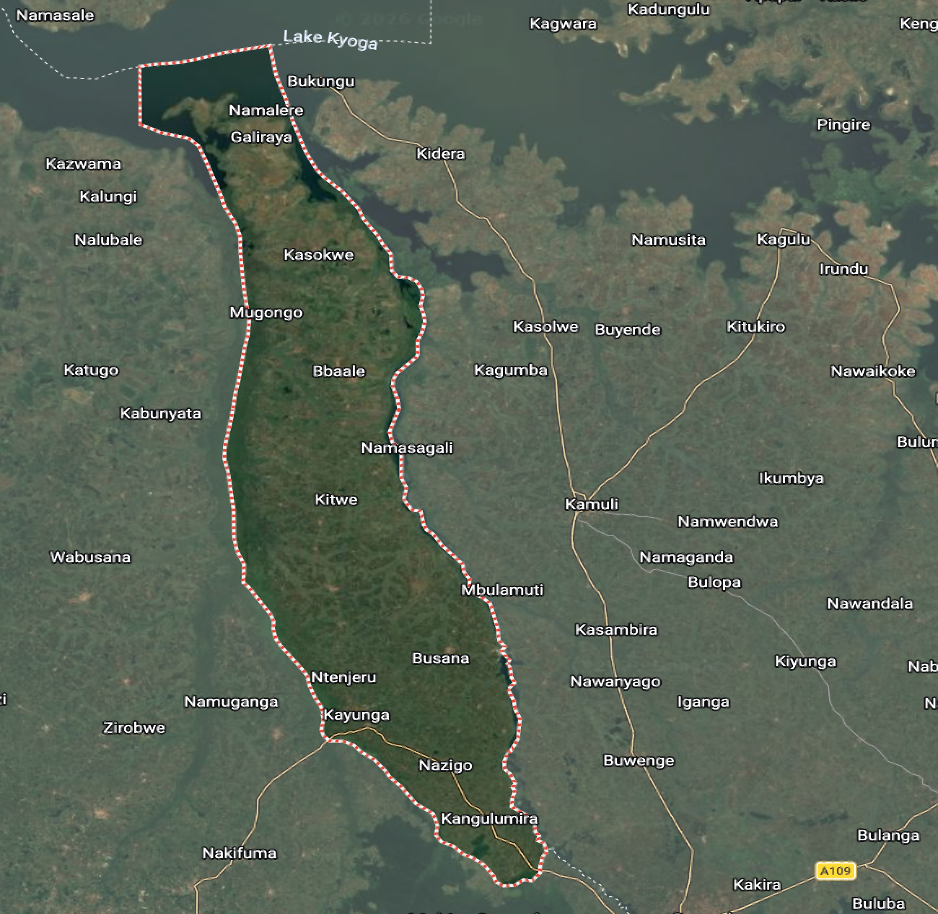
Satellite view of the Bugerere corridor from Galiraya to Jinja
Innovate UK Energy Catalyst

Cold chain + eMobility for Uganda's rural corridors.

A 24-month pilot building an integrated corridor operating system — from solar-powered cold storage to electric boda dispatch — across 186 km of the Galiraya–Kayunga–Mukono–Jinja corridor.

Galiraya Origin Hub Kayunga LMDP + Swap Hub Jinja Mini Hub Mukono Mini Hub Kampala Future 83 km truck 52 km e-boda 51 km e-boda SWAP GAP 100km > boda range Trunk (truck) E-boda route Future expansion
Scroll to explore

186 km

Corridor network

24 mo

Pilot duration

45

Cold storage

5

Electric bodas

150+

Farmers connected

5

Corridor nodes

Why this corridor

Three constraints.
One integrated response.

Between Galiraya and Kampala, agricultural output loses value at every stage — weak cold chain, unreliable transport, and fragmented energy operations. CBC treats these as one problem.

Problem

Value loss between farm and market

Without reliable cold storage, product quality degrades quickly. Farmers accept discounted pricing — losing 30-40% of potential revenue at the farmgate.

Solution

Two-hub corridor architecture

Solar-powered cold storage and battery charging at Galiraya; meat cutting, battery swap, and e-boda dispatch at Kayunga LMDP (grid-powered). Two hubs, one integrated control model across 186 km.

Outcome

Bankable operating evidence

Structured pilot data — utilization, unit economics, supply chain metrics — for funding decisions, corridor replication, and lender confidence.

Operating model

Source. Stabilize. Solve. Dispatch.

Four stages across a five-node corridor — from farm aggregation at Galiraya through the co-located hub at Kayunga, via mid-corridor swap hubs, to split-route delivery into Jinja and Mukono.

01

Production hub

Galiraya

Livestock receiving, slaughter, and primary processing at origin — before quality loss compounds. 45 m³ partitioned cold storage (0-4°C meat, 8-12°C vegetables) powered by off-grid solar (100 kWp / 275 kWh BESS). Batteries charged here overnight for the entire corridor.

02

Distribution + swap hub

Kayunga LMDP

Meat cutting (cut-to-order for restaurant and retail), cold holding (fridges + chest freezer), and a 20-position battery swap station — all grid-powered. Charged batteries and whole carcasses arrive by truck each morning; cut meat and charged e-bodas head out to Jinja and Mukono.

03

Battery swap gap

The range problem

E-bodas can't complete a 100 km round trip (Kayunga → Jinja → Kayunga) on a single charge. The solution: mid-corridor mini hubs at Jinja and Mukono — rented premises with 2 swap units and a cooler box each (£4,300 per site) — enabling continuous last-mile operations without range anxiety.

04

Split-route dispatch

Jinja + Mukono mini hubs

Route operations branch with controlled timing and traceable delivery. 5 e-bodas with insulated cooler boxes handle last-mile dispatch via two routes (51 km to Jinja, 52 km to Mukono), while a hybrid truck runs the 83 km trunk route daily from Galiraya.

Technical stack

Four modules. One operations layer.

01

Cold-chain core

45 m³ partitioned storage baseline with 0-4°C compliance-critical zone. Three thermal zones for meat, dairy, and vegetables — monitored continuously.

02

Mobility operations

Design range of 30-70 swaps/day with fleet routing and battery pool controls. 5 e-bodas (Phase 1) with insulated cooler boxes for temperature-controlled last-mile delivery from the Kayunga LMDP.

03

Energy baseline

100 kW PCS / 275 kWh BESS with ~100 kWp solar at Galiraya — off-grid architecture powering cold storage, battery charging, and community power. Kayunga LMDP swap station runs on grid with solar backup.

04

Data + governance

Operational evidence capture for M&E, lender confidence, and replication decisions. IoT telemetry, dispatch logs, and cold-chain compliance data feed the platform layer.

Consortium

Role clarity across delivery, operations, and integration.

Five partners, each with a defined scope and accountability. Built for execution, not committee.

System Integrator

Aegis Energy

Programme governance, system integration, replication architecture, and UK-side project management.

UK
Cold-Chain Specialist

SVRG

Cold-chain technical systems, temperature monitoring, compliance capability, carbon MRV, and M&E.

UK
Mobility Platform

Songa Mobility

Battery swap operations, route optimization, e-boda fleet setup, and mobility toolchain integration.

Kenya / Uganda
Local Delivery

LFF

Site readiness, permitting, civil works coordination, LMDP operations, and local execution.

Uganda
Demand + Operations

HABF

Farmer aggregation from an 8,500-member SAYE network, daily operations discipline, and utilization ramp.

Uganda
Pilot economics

Built for evidence, designed for scale.

Six profit centres

  • Cold chain facility 45 m³ storage at Galiraya hub
  • Kayunga LMDP Last-mile distribution + swap hub
  • Transport fleet 5 e-bodas + hybrid truck
  • Energy utility Solar/BESS + community power
  • Carbon / impact Carbon MRV + impact credits
  • Platform OS EMS, dispatch, IoT, service credits

Revenue trajectory

18-month pilot
£159k
Post-pilot annual (base)
£107k
Post-pilot annual (high)
£205k

Revenue from cold storage (crate-day pricing), swap fees, transport, energy retail, and platform services.

Budget architecture

Infrastructure (Galiraya + LMDP + Mini Hubs) £194k
Partner delivery (LFF + HABF) £138k
Lead partner (Aegis) £193k
Platform + M&E (Songa + PA) £82k
Programme contingency £30k

Grant ask: ~£638k  |  Total project value: ~£681k (incl. £43k in-kind)

24-month roadmap

Four phases. Clear gates.

Months 1-4

Mobilize

Procurement lock, site preparation, partner mobilization, and implementation sequencing.

Months 5-10

Commission

Core commissioning, cold-chain stabilization, swap station activation, and operational training rollout.

Months 11-18

Operate

Utilization ramp (30 to 70 swaps/day), route optimization, and evidence capture under live conditions.

Months 19-24

Consolidate

Performance consolidation, replication package assembly, and financing readiness outputs for corridor scale.

Get involved

Partner on the corridor build.

We are building CBC as an evidence-led operating system for practical scale across Uganda's agricultural corridors. If you work in climate finance, cold-chain infrastructure, electric mobility, or rural development — we'd like to hear from you.