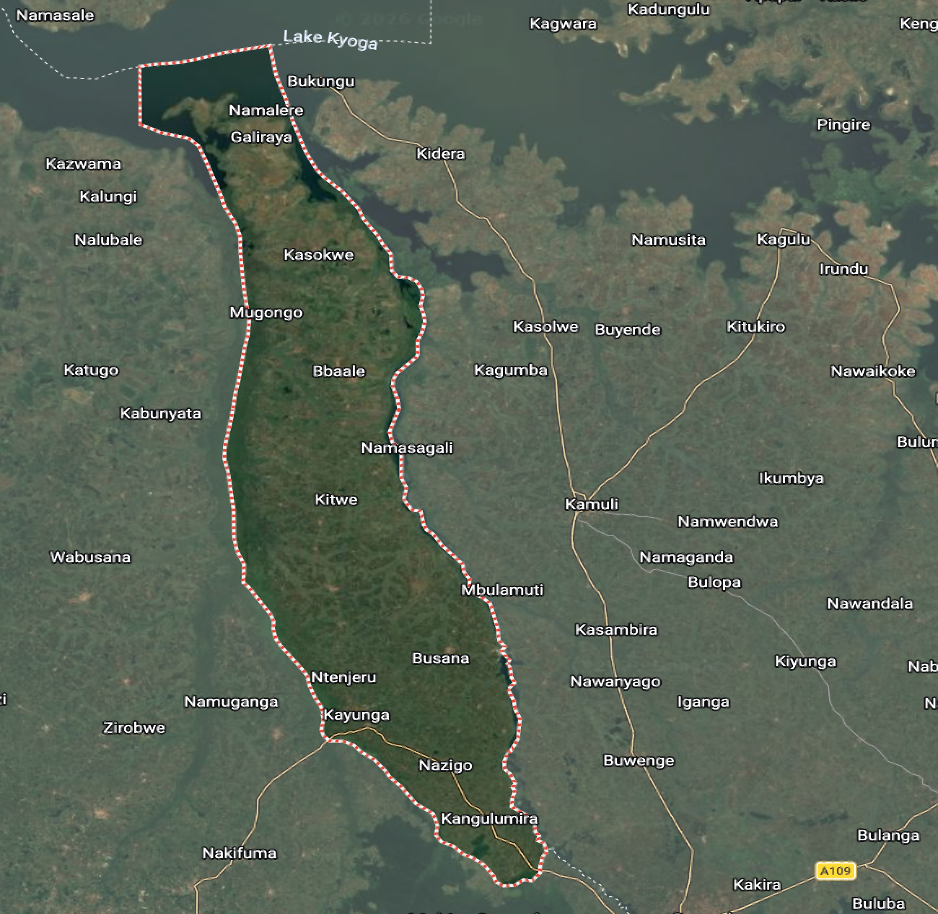
Satellite view of the Bugerere corridor from Kitimbwa to Jinja
Innovate UK Energy Catalyst

Cold chain + eMobility for Uganda's rural corridors.

A £1.5m, 24-month pilot building an integrated corridor operating system — from a modular mobile abattoir and solar-powered cold storage to electric fleet dispatch — across 180 km and 8 nodes of the Kitimbwa–Kayunga–Mukono–Jinja corridor.

Galiraya ▣ Rural + ◇ Dock Bbaale ▣ Rural + ◇ Dock Kitimbwa ■ Main Hub Kayunga ▣ Junction ▣ Mid-point ▣ Mid-point Mukono ▣ Urban Hub Jinja ▣ Urban Hub Kampala Future Canter daily 19 km trunk ~50 km e-boda ~50 km e-boda PRODUCTION ZONE mobile abattoir rotates 3 docks SWAP NETWORK 7 hubs, multi-OEM open ■ Main Hub (Kitimbwa) ▣ Containerised Hub (×7) ◇ Docking Station (×3) Canter Fuso (trunk) E-boda / eTrike route
Scroll to explore

180 km

Corridor network
8

Corridor nodes

45

Cold storage

10

Electric vehicles

6

Consortium partners

24 mo

Pilot duration

Why this corridor

Three constraints.
One integrated response.

Between Kitimbwa and Kampala, agricultural output loses value at every stage — weak cold chain, unreliable transport, and fragmented energy operations. CBC treats these as one problem.

Problem

Value loss between farm and market

Without reliable cold storage, product quality degrades quickly. Farmers accept discounted pricing — losing 30-40% of potential revenue at the farmgate.

Solution

A corridor operating system

The innovation is integration: a standardised architecture that orchestrates four networks under one OS. Solar energy powers cold storage and charges EV batteries; cold storage creates transport demand; electric transport connects farmers to premium buyers; revenue funds operations without ongoing subsidy. Components work — CBC proves the operating system that makes them investable.

Outcome

Prove one corridor, deploy many

CBC-1 builds, operates and commercially validates a single corridor — generating trading revenue within 12 months. Three customer groups: smallholder farmers gaining cold storage and premium prices, boda-boda riders accessing predictable battery swaps, and institutional buyers receiving certified produce. WP7 converts operational learning into a replication package — corridor‑as‑a‑service.

Operating model

Four networks. One operating system.

Solar energy powers cold storage and charges EV batteries. Cold storage creates demand for transport. Electric transport connects farmers to premium buyers. Revenue funds operations without ongoing subsidy. Each network carries a product innovation — the OS orchestrates all four.

01

Energy network

Aegis + SVRG

70.2 kWp solar + 225 kWh BESS hybrid at Kitimbwa powers the cold room and charges EV batteries across 7 containerised hubs. Automated dispatch protects cold chain first (Normal / Low-Solar / Recovery modes), throttles EV charging when solar is low, and targets ≥95% compliance.

02

Cold chain network

SVRG + LFF

45 m³ cold room at Kitimbwa (meat 0–4°C, veg 8–12°C, dairy 4–8°C) plus a modular mobile abattoir rotating three docking stations. Processing and chilling are decoupled — carcasses shuttle daily in custom chiller boxes while the 20ft container stays on-site. PCM thermal storage extends autonomy 8–12 hours beyond battery capacity.

03

EV transport network

Songa + Aegis

A mixed fleet optimised by segment: 5 eTrikes (500 kg cargo, rural collection), 5 e‑bodas (last-mile delivery), and a Canter Fuso 7.5t (83 km trunk route). Seven containerised swap hubs provide multi-OEM open charging across 180 km. No single vehicle serves the full corridor — multi-modal is the design, not a compromise.

04

Producer network

HABF + LFF

8,500 farmers in HABF’s SAYE network aggregate demand. Parish coordinators schedule livestock at docking stations; farmer wallets register the named primary cultivator with automated mobile money reconciliation. Prepaid service credits from cooperatives create 30–60 day forward revenue visibility — transforming pay-per-use into bankable contracts.

Daily operations

A day in the corridor.

Every day, the corridor moves meat from docking station to market and batteries from hub to rider. One cycle. Six handoffs. Six partners in sync.

5–7am Dawn

Mobile abattoir at docking station

Farmers walk livestock max 5 km to today’s docking station. The 20ft processing container — docked for 2–3 days at a time — handles slaughter, dressing, and inspection. Carcasses load straight into custom chiller boxes on the Canter Fuso flatbed.

HABF LFF
8–9am Transit

Canter delivers to Kitimbwa hub

Full chiller box loaded on the Canter Fuso heads to Kitimbwa main hub. Meanwhile, eTrikes collect produce from nearby farms (veg, dairy, 15–25 km radius). All corridor hubs open for community energy — phone charging, lighting.

LFF Songa
10am Processing

Kitimbwa cuts and dispatches

Chiller box unloads via A-frame into 45 m³ cold room. Cutting room processes cut-to-order for restaurants and retail. Batteries — charged overnight by the 70.2 kWp solar + 225 kWh BESS — load into swap racks. Riders check the Songa platform for today’s routes.

Songa HABF
10:30am Dispatch

Fleet dispatched to markets

5 e-bodas with insulated fridge boxes head out on two routes: Jinja (~50 km) and Mukono (~50 km). 5 eTrikes handle heavier cargo runs. IoT tracks location, battery level, cold chain temperature, and delivery status in real time across the corridor.

Songa Aegis
1–4pm Delivery

Mid-point swap and second runs

Riders arrive at urban hubs, deliver product, and swap depleted batteries at containerised hubs — 2 minutes per swap. Mid-corridor swap points bridge the 100 km range gap. Open network: community riders and other OEMs can also swap here.

Songa
6pm+ Return

Reverse logistics and recharge

Riders return depleted batteries and empty fridge boxes to Kitimbwa. Canter returns with the empty chiller box for tomorrow’s fill. Overnight, the solar+BESS system recharges all batteries. Order data shapes tomorrow’s slaughter. The corridor resets.

LFF SVRG
Technical stack

Four modules. One operations layer.

01

Cold-chain core

45 m³ partitioned storage baseline with 0-4°C compliance-critical zone. Three thermal zones for meat, dairy, and vegetables — monitored continuously.

02

Multi-modal mobility

Mixed fleet: 5 eTrikes (500 kg cargo), 5 e-bodas (last-mile fridge boxes), Canter Fuso 7.5t (trunk + abattoir repositioning). Seven containerised swap hubs along the corridor. Open, multi-OEM charging network.

03

Hybrid energy system

70.2 kWp solar + 225 kWh BESS at Kitimbwa main hub — hybrid architecture (grid available 13–16 hrs/day). Powers cold storage, battery charging, and community energy. Rural corridor hubs add distributed solar capacity. Automated dispatch: Normal / Low-Solar / Recovery modes.

04

Data + governance

Operational evidence capture for M&E, lender confidence, and replication decisions. IoT telemetry, dispatch logs, and cold-chain compliance data feed the platform layer.

What’s genuinely new

Four innovation tracks.

Innovate UK funds innovation, not operations. These are the four areas where CBC pushes beyond current practice — each designed to be tested, measured, and replicated.

Track A

Modular mobile abattoir

Current practice

Fixed abattoirs require animals to travel 20–70 km. Low utilisation. Processing and chilling in one unit — truck tied up in daily transit.

CBC target

Processing container stays at station 2–3 days; only chiller boxes shuttle daily. Kill decoupled from chill. 3× catchment area of a fixed facility. If demand shifts, move the container — zero new CAPEX.

Track B

Compliance controls

Current practice

Manual temperature checks. Paper records. No traceability from farm to point of sale. No alerting on excursions.

CBC target

Automated cold chain monitoring with threshold alerts. Digital chain-of-custody from slaughter to delivery. ≥95% time-in-spec target.

Track C

Battery health dispatch

Current practice

First-come-first-served charging. No state-of-health tracking. Riders get whichever battery is available — range is unpredictable.

CBC target

SoH-aware battery dispatch matching battery capacity to route distance. Predictive routing that accounts for payload, terrain, and degradation.

Track D

Open interoperability

Current practice

Fragmented e-mobility market — Zembo, Spiro, Ampersand, Rome all use different battery standards. Riders locked to one network. Infrastructure underutilised.

CBC target

Open, multi-OEM charging network across 7 hubs. Dual track: open charging for any EV + franchise for closed systems. CBC becomes infrastructure provider, not vehicle vendor. Community riders welcome.

Integration architecture

Four networks. Every partner has a lane.

Each network carries a product innovation. Each partner owns a lane. The Corridor OS orchestrates all four under common commissioning protocols, acceptance tests, and service levels — this is what replicates.

01

Energy network

70.2 kWp solar + 225 kWh BESS hybrid • Automated dispatch (Normal / Low-Solar / Recovery) • Cold chain always protected, EV charging throttled when solar is low • ≥95% compliance target.

Aegis Energy SVRG
02

Cold chain network

45 m³ cold room + modular mobile abattoir • PCM thermal storage for 8–12h grid-free autonomy • Processing decoupled from chilling — chiller boxes shuttle daily, container stays on-site.

SVRG LFF
03

EV transport network

Multi-modal fleet (eTrikes + e‑bodas + Canter Fuso) • Open multi-OEM charging across 7 hubs • Health-aware battery protocols targeting 2,500 cycles over 8 years • Fleet dispatch + IoT platform.

Songa Aegis
04

Producer network

8,500-farmer SAYE network • USSD wallet with payment integrity • Prepaid service credits from cooperatives • Parish coordinators aggregate demand at docking stations.

HABF LFF
Consortium

Every partner owns a network. Zero overlap.

Four networks, six partners. Each has a lane — non-overlapping roles that map directly to the integration architecture. Built for execution, not committee.

Energy Network + Integration

Aegis Energy

Energy system specification, dispatch logic, IoT platform, programme governance, and replication architecture. The OS custodian.

UK energy portfolio; FLF ScanSpot grant (10107189); Powerfarm Tanzania (10155036). Without Aegis, the pieces don’t connect — integration is the innovation. UK
Cold Chain + Smart Agri Centre

SVRG

Smart Agri Centre design and build, cold room commissioning, PCM specification, Innovex IoT monitoring, community engagement, and impact M&E.

Multiple IUK-funded solar agri-centre deployments across Uganda. Without SVRG, there’s no facility — proven deployments in Uganda. UK
EV Fleet + Swap Network

Songa Mobility

eTrikes, e‑bodas, swap cabinets, fleet IoT, dispatch platform, mobile money wallet, and multi-OEM interoperability. Full-stack from vehicle to software.

Kenya EV fleet and swap platform; rural multi-vehicle corridor validation. Without Songa, there’s no mobility — meat stays in Kayunga. Kenya / Uganda
Producer Network + Operations

LFF

Day-to-day hub operations, butchery team, Canter driver, site management, local procurement, and mobile money administration. The corridor’s operational backbone.

15-acre site in Bugerere sub-county; established government and community relationships. Without LFF, there’s no local presence — SVRG can’t operate in eastern Uganda alone. Uganda
Farmer Network + Demand

HABF

8,500-farmer SAYE network, parish coordinators, livestock scheduling at docking stations, demand aggregation, and cooperative service credit management.

Without HABF, there’s no demand — 8,500 farmers don’t walk in. Uganda
Community + GEDSI

NGO Partner

Community development, gender equality, disability and social inclusion (GEDSI), independent M&E support, and community engagement across the corridor.

Without the NGO, there’s no independent voice — community trust is earned, not assumed. Uganda
Pilot economics

Built for evidence, designed for scale.

Eight revenue streams

  • Cold storage 45 m³ 3-zone facility at Kitimbwa hub
  • Battery swap Multi-OEM open network, 7 corridor hubs
  • Last-mile delivery E-boda cold delivery with fridge boxes
  • Trunk logistics Canter Fuso daily run + abattoir repositioning
  • Meat processing Mobile abattoir: trading + fee-for-service
  • Retail energy Community power: phone charging, lighting
  • Platform OS EMS, dispatch, IoT, service credits
  • Data + carbon Carbon MRV unlocked at scale

Financial validation

Breakeven utilisation
52%
Net margin (realistic-adjusted)
41%
Payback period
~4.6 yr

Python financial model: 4-layer cascade, Monte Carlo stress-tested. No loss scenario under extreme assumptions. Revenue from 8 streams.

Unit economics over time

How per-unit pricing and margins evolve as the corridor matures — the direction of travel.

Pilot Months 1–24
Cold storage £0.40 /crate-day
Battery swap £1.25 /swap
Delivery £2.50 /trip
Energy retail £0.18 /kWh

Grant-supported. 30–50% utilization. Building operating evidence and validating demand.

Post-pilot Months 24–36
Cold storage £0.35 /crate-day
Battery swap £1.10 /swap
Delivery £2.00 /trip
Energy retail £0.15 /kWh

Commercial pricing. 60–70% utilization. Unit costs drop as fixed costs spread. Approaching breakeven.

Scale Months 36–60
Cold storage £0.28 /crate-day
Battery swap £0.90 /swap
Delivery £1.50 /trip
Energy + carbon £0.12 /kWh + carbon credit revenue

Multi-hub network. 80%+ utilization. Platform licensing fees. Carbon MRV unlocked. Unit costs ~30% below pilot.

Pricing is indicative — validated through pilot operations and adjusted at each gate review. Direction of travel, not commitments.

Theory of change

From context to impact — the ODA logic.

Every element of CBC maps to a causal chain. This is how grant-funded infrastructure translates into measurable poverty reduction and climate outcomes.

01

Context

  • Energy infrastructure deficit across rural Uganda
  • 20–30% income loss for smallholder livestock producers
  • Farmers below £1.90/day poverty line
  • Women comprise 70% of affected producers
02

Problem

  • No reliable cold chain between farm and market
  • Diesel-dependent transport (costly, polluting)
  • Fragmented energy, storage, and mobility systems
  • No integrated operating model exists
03

Intervention

  • Solar-powered main hub (70.2 kWp / 225 kWh hybrid) at Kitimbwa
  • 45 m³ cold storage + modular mobile abattoir
  • Multi-modal e-mobility (eTrikes + e-bodas, 7-hub swap network)
  • Automated dispatch control (≥95% cold chain compliance)
04

Outputs

  • 200–300 direct beneficiaries served
  • 70 battery swaps/day at target utilization
  • ≥95% cold chain time-in-spec compliance
  • Replication package validated by independent M&E
05

Outcomes

  • 15–20% income increase for farmers
  • 30–40% cost reduction for riders
  • ~168 tonnes CO&sub2;e/year avoided per hub
  • 70% of cold chain users are women
06

Impact

  • 50,000–60,000 farmers served across 9–13 hubs
  • 160–300 sustained jobs created
  • £5–8m private capital mobilised
  • Replicable model for East African corridors

24-month pilot validates Outputs + early Outcomes. Scale-out (3–5 corridors) delivers full Outcomes + Impact within 48 months.

24-month delivery timeline

Seven work packages. Three decision gates.

Every milestone is linked to a Go/No-Go decision. If a gate fails, the project descopes or pauses — not drifts.

123456 789101112 131415161718 192021222324
WP1 Programme Management
WP2 Design & Baseline
WP3 Infrastructure Build
WP4 Abattoir & Fleet
WP5 Operations & Evidence
WP6 Training & Capacity
WP7 Dissemination
Gates
G1
G2
G3
Milestones
G1

Anchor Demand Validation

Month 1, Week 2

GO criteria

  • Sufficient cold chain demand confirmed (HABF survey + trader interest)
  • Credible rider uptake established (expressions of interest)
  • At least one cooperative willing to pilot prepaid model

If NO-GO

Descope to minimum viable configuration; defer non-critical components; revisit at next quarterly review.

G2

Commissioning Acceptance

Month 6, Week 4

GO criteria

  • Cold chain time-in-spec targets met over 30-day acceptance test
  • Acceptable system uptime (inverter/BESS availability)
  • No critical safety issues; staff training complete

If NO-GO

Extend acceptance test; withhold installer retention; escalate if unresolved.

G3

Replication Readiness

Month 15 — Advisory

GO criteria

  • Replication dry-run at second site shows viable uptake trajectory
  • Investor or DFI interest validated for multi-hub financing

If weak

Not blocking — defer scale-out to post-pilot. Focus on evidence consolidation.

Where we are

This isn’t starting from scratch.

The corridor model has been designed, costed, and validated. Partners are engaged. What’s needed now is the funding decision.

Done

Strategic pivot complete

Hub location shifted from Galiraya to Kitimbwa Trading Centre. Mobile abattoir design, 8-node corridor model, 3 infrastructure types defined. Budget rebuilt from scratch (v4, £1.17M, 7 IUK-prescribed work packages).

Done

Financial model validated

Python model: 4-layer cascade, 8 revenue streams, 41% net margin. Monte Carlo stress-tested — no loss scenario under extreme assumptions. Breakeven at 52% utilisation. 4.6-year payback.

Done

Energy + cold chain locked

70.2 kWp solar + 225 kWh BESS hybrid system at Kitimbwa (grid 13–16 hrs/day). 45 m³ 3-zone cold room: meat 0–4°C, veg 8–12°C, dairy 4–8°C. Automated dispatch: Normal / Low-Solar / Recovery modes.

Done

Six-partner consortium assembled

Aegis Energy, SVRG, Songa Mobility, LFF, HABF, and NGO partner engaged. Songa pricing confirmed ($31,500 hardware). SVRG scope agreed (£140k, 12%). HABF brings 8,500-farmer SAYE network.

Done

Kenya dual deployment agreed

Songa handling Kenya-side hub (EV charging focus). Dual deployment (Uganda + Kenya) within existing budget envelope. Tanzania CFI grant (Powerfarm, Apr 2025) provides additional credibility evidence.

Now

IUK portal answers (Q12–Q24)

13 scored questions being drafted using three-layer answer framework (ATRPP persuasion + DRIVE35 depth + source material). Portal deadline: 25 March 2026. Appendices (PM, risk register) complete.

Next

Submit & mobilise

Upon funding: consortium MoU signed, equipment RFQs issued, Kitimbwa site preparation begins, baseline study launched. Gate 1 (demand validation) at Month 2.

Get involved

Partner on the corridor build.

We are building CBC as an evidence-led operating system for practical scale across Uganda's agricultural corridors. If you work in climate finance, cold-chain infrastructure, electric mobility, or rural development — we'd like to hear from you.